


Daniel, why is there such a growing interest in family trees?
Around 2010, interest skyrocketed and it's holding. Archives started going digital, people started doing their own research. The huge number of articles on how to build a family tree spurred further interest. Until then, one always had to go to the archives. Even so, the search is not so simple.
How did you personally get into compiling family trees?
I've been interested in them from a very early age. My grandfather used to tell me how our family came from France. I was intrigued, and I started researching. I was about 10 years old. Around the age of 14, I wanted to go to the archives in person, but that was a problem. You can only go there with an ID card, which you get at 15.
There was a little difficulty with reading old handwriting, but that completely gave in within a few years. The hobby gradually became my job.
Are there any courses of study or institutions where family genealogy can be learned?
Directly this field is not very good to study. History is probably the closest, but even there the subject of family trees is more likely to be only hinted at.
There is the Czech Genealogical and Heraldic Society in Prague. It has about 2,200 members, but half of them are probably no longer alive. About 1,000 members are enthusiastic amateurs who enjoy subscribing to the society's journal.
You promise to trace the family tree back 8 or more generations. Could there be blind spots?
When I don't know in my search, I stop. Typically around 1790, when the major civil registration reform of Joseph II took place.
Blind spots can arise later, though. They can be caused, for example, by unknown fathers for illegitimate children. For example, a child was born around 1913, the mother did not name the father and there is nothing that can be done about it under the law. There was a maternity hospital for unmarried mothers in Prague, U Apolináře, and this happens quite often there.
Sometimes I also find the father's name only faintly written in pencil in the record. Then a few years later the couple could have married and confirmed the assumption. It can also be checked by genetic tests.

How do such genetic tests work and how much do they cost?
They are done from saliva and take about 5 weeks to complete. More complex tests take 2 to 2.5 months. The most complex tests take up to six months to complete, but the results are worth it. You can confirm relationships going back 400 or 500 years.
Simpler tests are available at a discount and cost around 800 CZK. The subscription box simply arrives at home. More complicated tests can only be done on the male line. They can cost around 10,000 CZK.
On average, you finish your pedigree around what year?
If the customer wants, it's no problem to get to 1700. However, often around 1800, family trees are leaky because, for example, the local parish burned down, etc.
These brief entries between 1784 and 1800 relate to Joseph II's reforms, when even older sources exist, but cannot be reliably linked to them because typically the names of parents or place of origin were not written for fiancés in those years, only approximate ages.
When you are dealing with more recent years around 1900 to 1930, what is the procedure?
I go in person to the registry office, the laws don't allow you to send documents remotely. The registrar usually knows about my search in advance and prepares the documents for me.
Compared to Slovakia, we are in a good position. There, for a long time, only the name and age of the parents were recorded. That makes it virtually impossible to search in Slovakia. In the history of the Austro-Hungarian Empire, we were under Austria and the Slovaks were under Hungary.
If we go further, for example Switzerland or Iceland have mostly good records.
What is the most common motivation for people to buy a family tree from you?
Mostly purely out of interest. For example, my dad is interested in ancestors and his birthday is coming up. The finished family tree also makes a nice gift and I keep it carefully stored with me for future generations. If someone writes that they have lost it, it is no problem to supply it again.
What information do you need from those interested in the family tree?
Name, date and most importantly place of birth, but not of a living person, but of a person who was born at least 100 years ago.
This information is best found in older birth, baptismal or marriage certificates.
An ideal basis for a search is, for example, the following: grandmother Anna Holá, born on 1 July 1913 in Čáslav.
Of course, one can search younger books as well, but often a power of attorney of a descendant is needed, so that no one finds out potentially sensitive information about people still alive.
How far in advance should donors enquire about the service?
Ideally about 6 months. Two is fine, but I'd have to start immediately. Be careful before Christmas, there's a lot of work there.
What percentage of people then go on to develop their family tree?
That's 15%. The die-hards are about 5%, they keep adding a little bit every month, so some jobs are still running. I'm pleased about that, I'm interested in making the family tree as interesting as possible. Generations of ancestors are growing at an incredible rate, there are easily thousands of them in the next generation.
You can go back to doing a family tree years later. For example, when an aunt has a round birthday and the family wants to complete her ancestral line.
What if a potential new husband joins the family?
Sometimes people wonder before or after a wedding if they are related. I've also dealt with a case of two people with a rare surname in the past. They also asked if they were related. And indeed, it turned out that they had a common ancestor 200 years ago.
For example, in the villages of South Moravia, this was common. Generally in gated communities it's more common.
How often do people ask if they have a noble ancestor and want to find them?
They do ask, but it's rare in real life. The Habsburgs intermarried a lot, but other earls didn't. It's more likely to find lower nobility in the family trees. Vladyka or knights. This too split around 1500 and the layers didn't mix as much.
Sometimes, for example around 200 years ago, I also come across a relation to someone famous.
It's also interesting that in 3 different family trees I've come across the same person historically. Apparently he had a lot of children.
Can you trace historical milestones in family trees as well?
Already with the industrial revolution around the middle of the 19th century, people moved a lot to the cities. From 1918 onwards, society changed a lot and people started to move even more. Around 1920 they also started to leave the church and divorce more.
As far as earlier dates go, the furthest we can go is the Thirty Years' War. Then, for example, the castle started to register the serfs so that they knew how much to collect from each cottage in taxes. Then every village had its own book.
Newly you also offer the creation of a coat of arms or personal emblem. How does it work?
It was actually Adrop's idea. The coat of arms itself is created by a graphic designer based on a template he gets from me.
I interview the customer about where their ancestors were from, what they do for a living, and what their ancestors did. I then suggest variations, commission the graphic designer to create the design and he will suggest two colour schemes. The customer chooses between them.
But it's all bounded by rules. You can't put anything on a coat of arms. The finished coat of arms is then registered with the Genealogical and Heraldic Society in Prague.
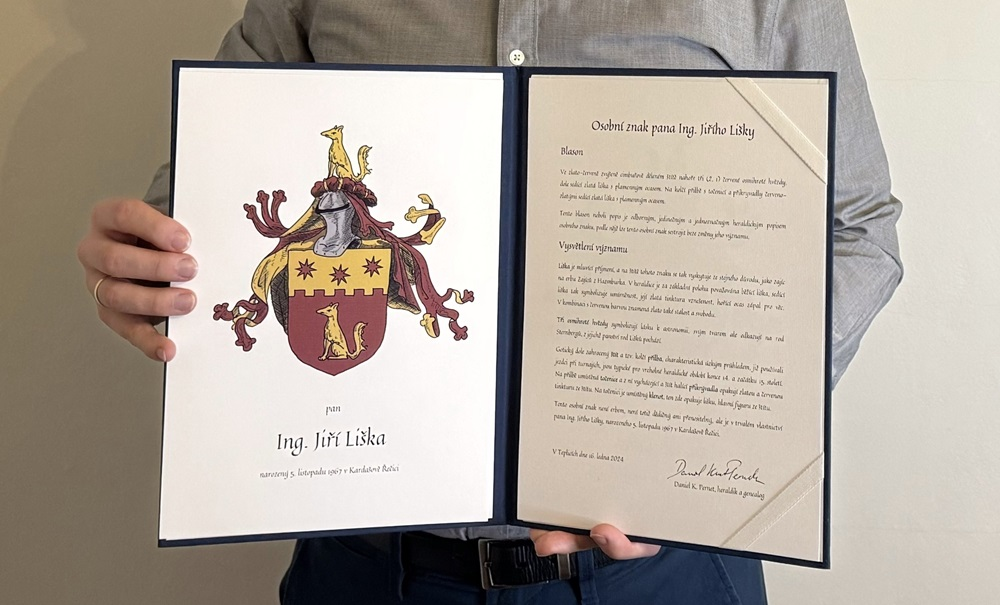
What might such a coat of arms look like?
It usually has multiple fields depending on what characterizes the customer. Often there are lions and eagles, and objects such as miners' hammers.
Which colours are most common?
We have 6 basic ones: green, white, blue and black and metals: gold and silver. We can also recognize purple, which is used a lot by the church. The choice of these colours dates back to the 12th century, they were painted on the shields of crusaders so that people could be seen from a distance and you could tell who was who.
Exceptionally, other colours can be chosen, but I don't advise it too much, the Society may not recognise the armorial inscription.
What symbols do we see most often on the coat of arms?
There are about 10 of them. For example, the hammer, the open book, the staff of Aesculapius as a symbol of the physicians, or the so-called law of the swift, which was a symbol of the power of the swift.
Where do we use our own coat of arms then?
For example, in an automatic email signature, a company logo or on a stamp or seal. We also plan to offer these in the future.
Customers will receive the coat of arms in both paper and electronic form and the use is entirely up to them.
Daniel, thank you for the wonderful talk and we wish you as many successful family trees and successful personal coats of arms as possible.


