

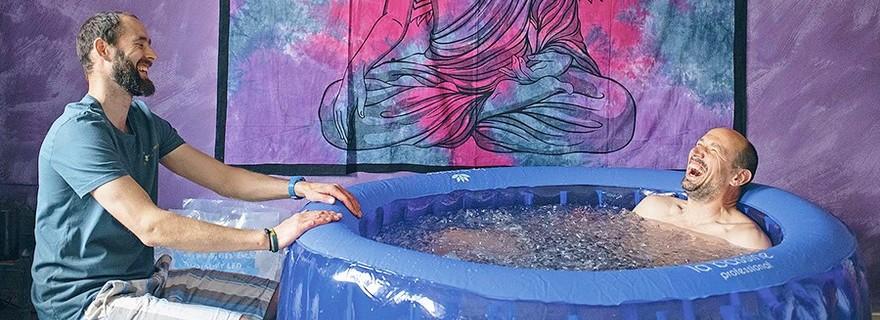

When you feel good, everything goes better, describes the benefits of the Wim Hof method
Wim Hof's method of hardening and breathing exercises is taking the world by storm. It is based on functional principles proven by thousands of years of practice. How does it all work? Jakub Chomát, an accredited coach of the Wim Hof Method, will tell you.
Jakub, what is the basis of the Wim Hof Method and what does it include?
It is really based on principles proven by centuries. It involves working with cold, breathing techniques, but also mind-set. The author Wim Hof, who sorted all these methods and ideas, was inspired by nature and tried everything out for himself.

Source :www.jakubchomat.cz
We have also heard the opinion that Wim himself is actually a kind of natural anomaly: a man who climbs mountains in shorts, etc. Does his method really work on everyone?
A lot of people tend to contradict it. They claim that Wim Hof is a natural phenomenon, etc. But that's not the point. It's about where we're going. We don't all aim to climb Mount Everest in our underwear. But we all want to be happy. It's directly related to overall health. When we feel bad, we're not effective at anything.
And vice versa: As soon as we get up with good energy, everything gets better. Feeling good is, in my opinion, the cornerstone of (almost) everything. Whether or not Wim Hof itself is a natural anomaly is not that important from my point of view.
What was your relationship with winter and hardening before you started the method?
I associated winter with illness, i.e. fear for my health and something a priori unpleasant. I had a thought in my head: If I don't get dressed, I'll get sick. Gradually, through cold showers and breath and mind work, I got rid of this automatism.
If someone wants to apply only breathing exercises, is it possible?
Sure. It's possible to do just breathing techniques and kick up the production of white blood cells, for example. The breathing techniques we learn in the Wim Hof method are anti-inflammatory, they support the autonomic nervous system, and we can consciously influence our immunity through them.
But you don't take a picture of yourself breathing on social media. With hardening, yes. The vast majority of people in my experience come to the Wim Hof method through hardening and feel that "that's what it's all about".
But our goal is that they look for the more conscious part behind it all. Not just cool pictures.
.jpg)
Where can we see examples of breathing exercises and the whole Wim Hof method in general?
I'd recommend the original Wim Hof app, available for both Google and Android. There are also various e-learning courses. When the situation permits live courses as well. You can also find a little bit about each pillar on my YouTube channel.
Several books have been published on the subject. Which one is the best?
Probably the most recent, and the only biographical one, is called Wim Hof The Ice Man. It has also been published as an audiobook. I think it's the best.
Also, investigative journalist Scott Carney describes his experience with the method in his book What Won't Kill You. It's also out in audio and print. Interestingly, this journalist originally came to Holland to discredit the Wim Hof method in a report for Playboy magazine. In the end, however, he was enthusiastic about it.
From the Czech ones I recommend the book The Apprentice of Ice by my colleague Hana Moravčíková. She describes, among other things, her testimony about how she climbed Sněžka in difficult conditions.
How did you personally come to the method?
Through cold feet. I blamed my wife for not dressing our children enough and making them sick. She showed me a video by Wim Hof and gave me a challenge to start hardening myself with cold showers. After just a few weeks, I could see how much it was helping and that I didn't need so many layers of clothing anymore. Cold showers helped me jumpstart each day.
Then you went to a workshop with Wim Hof. What was the greatest experience?
I was excited about the whole workshop. The whole 2 minutes in the ice water was a powerful experience. I had already had a training from that shower where I dosed the "cold" gradually. I think a cold shower is the perfect bridge for winterization. But nothing to worry about. 2 minutes in the ice can be given without preparation. Moreover, it is not a necessary part of the course. Only those who feel up to it will take advantage of this opportunity.
How does the original workshop work?
It starts with a life story. This is what the book The Ice Man by Wim Hof is all about. He didn't have it easy. His wife couldn't handle the anxiety and took her own life. He also showed a lot of the science behind his method.
Then there were breathing techniques and preparation for an ice bath. Then a group dive into the pools in groups of 8 to 10.
Is there still a workshop with Wim Hof himself?
Until 2020, there was an annual worldwide tour in several locations in Europe, Australia, America. But due to the pandemic, it's been put on hold. The event was normally attended by about 250 to 300 people. In the US there were bigger ones, for about 800 to 900 people.
What effects does the method promise? Who will it help?
One Australian university has been researching the effects of the method, particularly in relation to autoimmune diseases, anxiety and depression. For a large proportion of respondents, the problems diminished or disappeared altogether. In my practice, I see people with various autoimmune diseases: arthritis, seemingly untreatable inflammatory bowel disease and more.
The big killer of people living in the Western world is cardiovascular failure. This too can be trained by hardening.
How exactly do hardening and breathing exercises help?
In general, they help correct and reduce inflammation in the body. Chronic untreated inflammation is the basis of virtually all diseases of civilization common in the West. By toughening up we actually indulge in a kind of micro fitness for the muscles around the bloodstream, helping to lower blood pressure in the long term and bringing about the production of "happy hormones".
.jpg)
And as for anxiety or depression?
Through breathing techniques, we can consciously activate the production of those very happy hormones of joy: serotonin and dopamine. We feel more in touch with our experience and our body. People with anxiety and depression consciously learn to feel in control of their lives. Then when something bad happens, they indulge in breathing techniques and feel better. The better feeling of breathing comes immediately, so they are comfortable and well in their body.
It's a new experience for a lot of people. In contrast, antidepressants change the chemical composition in the brain. But they only work for the time they're on. And when they wear off, you feel the need to take another one, and so on and on - it's basically a brilliant business plan for the manufacturers. Breathing exercises can affect mood consciously. Whether enough to be able to come off medication is very individual, but according to that Australian study, there are already testimonies from quite a few people who describe being able to reduce to coming off medication.
How do your workshops work in the covid era?
We follow the terms and conditions and the rules of the "dog". Breathing techniques can be suggested by people on their own. We don't have to meet for that. But you can't do the whole workshop online. I don't just teach breathing techniques there. Hopefully there will be at least some loosening soon. With warmer weather, we could conduct the workshop completely outdoors.
The workshop is similar to the original one by Wim Hof?
Yes. We start with an introduction, introducing the pillars of the method, "playing" with the cold and the principles of working with the mind. This is followed by a whole session on breathing, where we learn how to breathe properly. The vast majority of people don't have the right habits. This is followed by a voluntary full-body bath in ice water. It's definitely better to meet in person.
1.JPG)
What comes after the workshop?
In the meantime, online consultations or, when the epidemic permits, personal one-on-one coaching are possible. People ask practical questions, when the method is suitable for them and when it is not, how to use it, etc.
What are the most common questions?
They tend to be technical. How many times and for how long to do different exercises or activities, what to watch out for so that you don't hurt yourself. Whether to toughen up after a sporting event, whether to toughen up children, etc. The answers depend on the health conditions of the client. My advice is to pay attention to your body's cues rather than "chasing" some performance and times. I guide clients to develop mindfulness.
What about ice water, is immersion necessary in the workshop/the whole method?
The dive is optional. The key is to respect your own feelings. It is a challenge for each person. The main thing is to sense when you feel like it and not overdo it. Respect your body.
As for Wim Hof's original workshop, there is a 2 minute dive into the ice water as the finale of the day. Physically, almost anyone can do it. It's all about mentally allowing yourself to do it.
And can anyone do the actual hardening? How many people leave it?
A lot of people drop out. They try it and they find it's not for them. It's a matter of intent. When someone does it because other people are doing it, the motivation is often not enough. If they're like me, and they're annoyed that they're being held back by cold feet, they're more likely to stick it out.
The influence of social media has made hardening up a trend for a lot of people - rather than a life-changing challenge. People often "just" want a pretty picture, don't check the info around them and go try it too. And that doesn't get them very excited. This goes back to motivation again.
So how do you go about hardening up the right way?
For someone who hasn't been dedicated to staying cool their whole life, consistency, respect and kindness to yourself is in order. Entering into the whole process consciously. It is certainly not a good idea to go unprepared into icy water.
TIP: Read our colleague Tom's experience with hardening.

What made you spread the Wim Hof method?
The personal realization that it is within our power to change any functional automatism. We all have something like that in our bodies. Something that used to work but doesn't anymore. We have our health, our immunity, our mental well-being in our hands more than we realize. I want to show people that they don't have to be victims of their bodies.
Can it also help with the anxieties associated with the coronavirus pandemic?
The coronavirus pandemic brings a lot of fear. I want to show centuries-old techniques to help yourself from negative feelings. Breath, cold and water are available to all of us. We just need to know these tools. The whole method is simple, functional and accessible. That's why it makes sense for me to spread it at this time.
Can you add a few final tips?
Our mind and body can do more than we think. It's about not wanting everything right away, but making small changes towards what we want. Just start and take baby steps.
_(1).jpg)


